Artificial intelligence adoption inside enterprises is accelerating at a pace that governance simply cannot match.
While organizations invest in official AI strategies, a parallel ecosystem is quietly emerging - one that operates outside visibility, control, and security frameworks. This is Shadow AI. And it may already exist inside your organization.
Shadow AI is not just a technical issue. It is a governance failure, a data risk, and increasingly, a business liability. In 2026, it has become one of the most critical cybersecurity challenges - not because of malicious actors, but because of uncontrolled adoption happening from within.
At IronProbe, we have seen organizations with strong security postures fall vulnerable - not due to weak infrastructure, but due to AI usage happening entirely beyond security oversight.
Shadow AI: The Risk Your CISO Doesn't Know About Yet
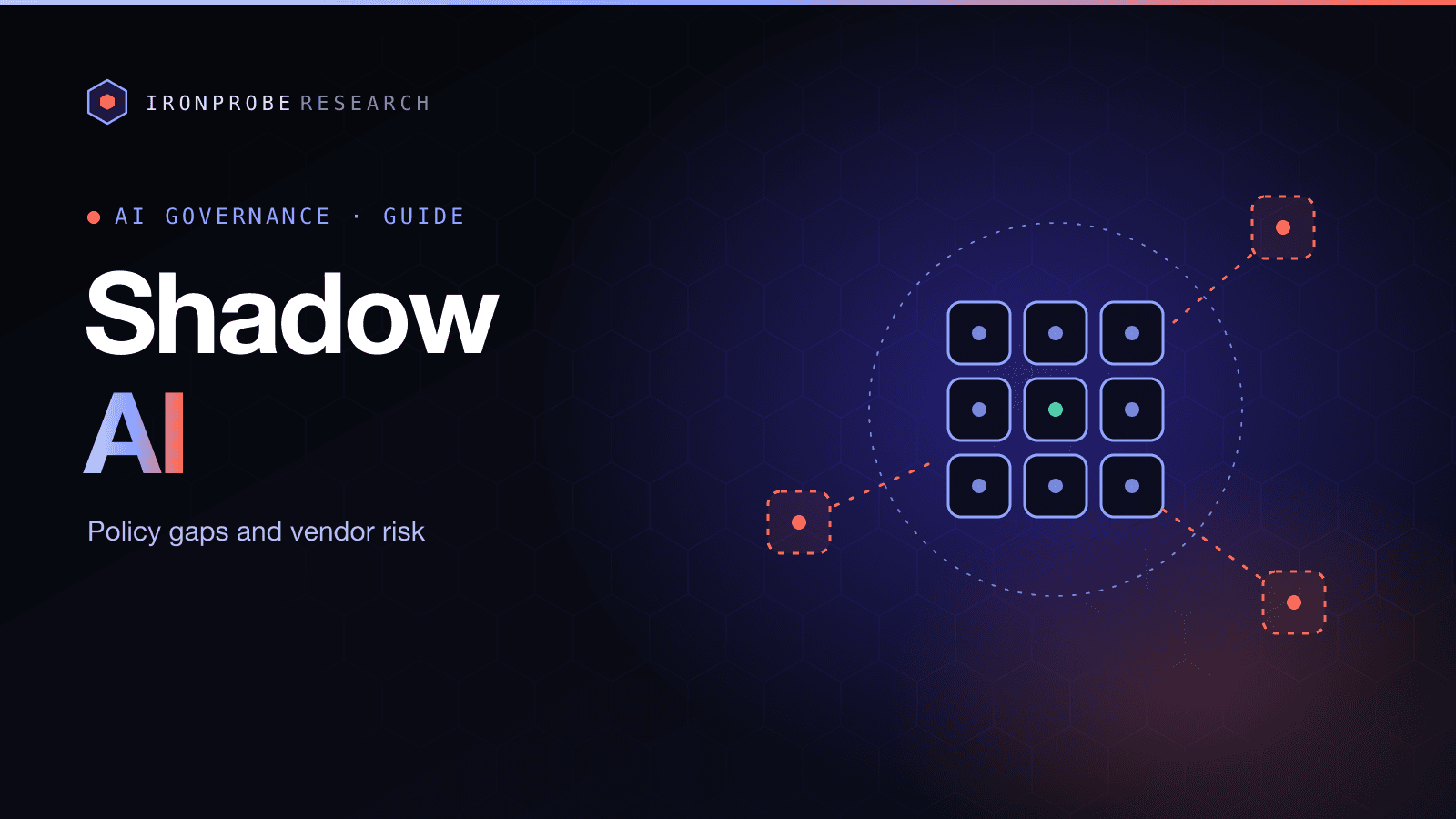
Shadow AI refers to the use of AI tools, models, or workflows without approval or visibility from IT or security teams. It is the natural evolution of shadow IT - but far more dangerous.
Unlike traditional shadow IT, which involved unauthorized applications or cloud tools, Shadow AI interacts directly with sensitive data, business logic, and decision-making systems. The consequences of exposure are not just technical - they are strategic.
Why Shadow AI Is Growing So Fast
The rise of Shadow AI is not accidental - it is driven by convenience. Employees use AI tools to increase productivity, teams adopt external AI APIs to move faster, and developers integrate AI features without completing a full security review.
Studies show that more than half of organizations suspect employees are using unapproved AI tools, exposing a critical visibility gap at the governance layer. Around 38 percent of employees admit sharing sensitive data with AI tools without approval, and many report accepting security risk when AI offers productivity gains. The result is a structural problem: high adoption combined with low governance produces compounding risk.
How Shadow AI Is Already Impacting Security
Recent security incidents demonstrate how rapidly AI risks escalate when governance is weak or absent.
- Unauthorized access to advanced AI systems has raised serious concerns about misuse and lack of containment in enterprise deployments
- AI agents with excessive permissions have been exploited to gain full system control across tens of thousands of affected deployments
- Enterprises are reporting a surge in Shadow AI adoption driven by unclear governance and intense pressure to ship AI-powered features quickly
These are not isolated incidents. They are early signals of a systemic shift in the enterprise AI threat landscape - one that is accelerating faster than most security teams recognize.
The Hidden Risks of Shadow AI
- Data leakage - sensitive company data sent to external AI tools without oversight or contractual data handling protections
- Compliance violations - breaches of GDPR, internal data policies, or client agreements triggered by unapproved AI usage
- Unmonitored integrations - AI tools connecting to internal systems without security review or access control enforcement
- Decision integrity risks - business decisions influenced by unverified, manipulated, or hallucinated AI outputs
- Expanded attack surface - new entry points introduced through unauthorized AI APIs, browser plugins, and autonomous agents
Shadow AI incidents have been shown to add hundreds of thousands of dollars per incident in breach costs - far exceeding any productivity gains from unmanaged AI adoption.
Building an AI Security Policy from Scratch
Most organizations are trying to retrofit AI into existing security policies. That approach fails.
AI is not just another tool. It requires a dedicated security and governance framework that balances two competing realities: AI adoption cannot be stopped, and AI risk cannot be ignored. Organizations that ignore either side of this equation end up either blocking productivity or accumulating hidden exposure.
AI Usage Governance
Define which tools are approved, which use cases are permitted, and what data can be shared with external AI systems. Avoid blanket bans - restrictions that are too broad only increase shadow usage without reducing risk, as employees will find workarounds that are even harder to detect.
Data Classification and Handling
Clearly define what data is allowed in AI systems and what must never leave the organization's control. This is foundational because Shadow AI most commonly starts with data misuse - not with a system compromise - and data that enters an external AI system may be retained, logged, or used for training without explicit disclosure.
Access and Identity Controls
- Enforce least-privilege access across all AI tool integrations and API connections
- Restrict AI tool permissions to the minimum scope required for each approved use case
- Monitor API usage and alert on anomalous access patterns or unexpected data volumes
Model and Integration Security
- Validate all AI integrations through a security review before connecting them to internal systems
- Audit APIs, plugins, and agent configurations on a regular schedule - not just at initial deployment
- Ensure architecture design decisions for AI-connected systems are reviewed against a defined security baseline
Monitoring and Logging
- Track AI usage patterns across teams and business units to surface shadow adoption early
- Detect and flag unauthorized tools and unapproved AI integrations as part of continuous monitoring
- Maintain full audit trails of AI interactions, data access events, and integration activity
Incident Response for AI
Traditional incident response plans do not cover AI-specific failure modes. Organizations need AI-specific breach scenarios, prompt injection response playbooks, and data leakage containment strategies built into their IR runbooks before an incident - not during one.
Continuous Security Testing
This is where most AI policies fail. AI systems are dynamic - they change as models are updated, data sources evolve, and integrations expand. Security must be continuously tested, not statically defined at the point of initial deployment.
At IronProbe, we help organizations move from policy on paper to security in practice - ensuring governance frameworks are actually enforceable under real-world adversarial conditions, not just on paper during an audit.
How to Evaluate AI Vendors for Security Risk
One of the most underestimated risks in 2026 is third-party AI vendors. Organizations often assume that using a well-known AI provider guarantees a baseline of security. It does not.
Risk does not just come from the model. It comes from how data is handled, how integrations are architected, what the vendor logs and retains, and how the system behaves under adversarial conditions that the vendor never tested for.
Why Vendor Risk Is Critical in AI
AI vendors typically process sensitive business data, integrate deeply into internal workflows, and operate as black-box systems with limited transparency into their internal architecture. This creates a structural problem: you inherit the vendor's security posture without full visibility into how that risk is actually managed.
Data Security and Privacy
- Where is your data stored and processed, and in which jurisdictions?
- Is your data used for model training, fine-tuning, or evaluation by the vendor?
- How is data encrypted at rest and in transit, and how is tenant isolation enforced across shared infrastructure?
Architecture and Integration Risk
- How does the AI integrate with your internal systems, APIs, and data sources?
- What permissions does the integration require, and can they be scoped down to the minimum needed?
- Can the AI trigger autonomous actions in connected systems, and what guardrails constrain that behavior?
Model Behavior and Safety
- Has the model been tested for prompt injection, jailbreaks, and adversarial inputs?
- How are model outputs validated before being surfaced to end users or downstream systems?
- What safety controls, content filters, and output guardrails are in place and configurable?
Compliance and Governance
- Does the vendor align with GDPR, HIPAA, SOC 2, and other regulations relevant to your industry?
- Are audit logs available, exportable, and complete enough for compliance and incident investigation?
- Can you enforce your own data handling and retention policies within the vendor's platform?
Security Testing and Transparency
- Has the system been independently security-tested by a qualified third party, and when was that last done?
- Are vulnerabilities disclosed responsibly and addressed on a defined remediation timeline?
- Does the vendor operate a bug bounty program or maintain a formal security research engagement process?
The Common Mistake in AI Vendor Evaluation
Most organizations evaluate AI vendors the same way they evaluate SaaS tools - reviewing pricing, features, and uptime SLAs. AI is not SaaS. AI systems are probabilistic, dynamic, and context-driven. Traditional vendor assessment frameworks were not designed to surface the risks that matter most in AI deployments, which means critical exposure remains invisible until after an incident forces a review.
Why Traditional Security Approaches Are Failing
The core issue connecting Shadow AI, policy gaps, and vendor risk is the same underlying problem: organizations are applying old security models to fundamentally new systems.
Traditional security assumes predictable inputs, defined behavior, and clear operational boundaries. AI systems break all three assumptions simultaneously. This is why Shadow AI goes undetected by existing controls, why governance policies fail in practice despite looking complete on paper, and why vendor risks remain hidden until a breach forces them into visibility.
The biggest AI risk in 2026 is not the model itself - it is the absence of control, visibility, and governance around how that model is used inside your organization.
How IronProbe Helps Organizations Secure AI
Most organizations are still in the early stages of AI security maturity - focused on compliance checklists and documentation rather than real-world threat simulation. IronProbe operates at the next level, combining offensive security methodology with deep AI-specific expertise.
Our Approach
- AI pentesting - simulating real attacks against LLM systems, AI agents, and connected integrations
- Shadow AI discovery and audit - identifying unauthorized and unmanaged AI usage across the organization
- Vendor risk assessment - evaluating third-party AI tools against rigorous, AI-specific security criteria
- Policy validation through attack simulation - testing whether governance frameworks hold under real adversarial pressure, not just audit conditions
What Makes IronProbe Different
- Offensive-first mindset - we test the way attackers think, not the way compliance auditors check boxes
- AI-specific threat modeling - built around how AI systems actually fail in production, not how traditional software fails
- End-to-end system coverage - from data ingestion through model inference to output and integration layers
- Business-impact-driven reporting - findings are tied to actual organizational risk, not abstract vulnerability scores
In real-world scenarios, risks do not exist in isolation. They emerge from how AI is used, integrated, and governed across an organization. IronProbe maps those interactions, identifies where trust assumptions and control gaps create exploitable exposure, and helps organizations build defenses that work in practice.
The Future of AI Governance and Security
The next phase of enterprise cybersecurity will not be defined by infrastructure hardening - it will be defined by AI governance.
We are already tracking Shadow AI shifting from exception to norm in enterprise environments, AI-driven attack surfaces expanding across every business function, regulatory pressure increasing globally around AI usage accountability, and AI vendor ecosystems growing far faster than the frameworks designed to evaluate them.
The most important takeaway for CISOs and security leaders is this: the biggest AI risk is not the model. It is the lack of control around it - the gaps in visibility, governance, and testing that allow risk to accumulate silently until it becomes a breach.
Final Thoughts
Shadow AI is not a future problem. It is already inside organizations right now - unseen, unmanaged, and consistently underestimated by the teams responsible for securing everything else.
The organizations that address it proactively will prevent data breaches, build institutional trust, and scale AI safely. The ones that ignore it will face compliance failures, security incidents, and a loss of control over systems they did not even know were running.
In 2026, you cannot secure what you do not know exists. That visibility gap is exactly where the real risk lives - and where IronProbe starts.
IronProbe Security
Is Your AI Agent Actually Secure?
IronProbe specializes in AI agent security audits, adversarial prompt injection testing, and secure AI architecture design. We red-team your AI systems the way real attackers do - before they get the chance.