Retrieval-Augmented Generation (RAG) was supposed to fix AI's biggest weakness - hallucination.
By grounding responses in real data, RAG enables AI systems to access internal documents, knowledge bases, and real-time information. It powers enterprise copilots, support bots, and decision systems. But in solving one problem, RAG has introduced another - and a far more dangerous one.
Your AI now trusts external data as truth. And attackers know exactly how to exploit that.
At IronProbe, we have seen organizations invest heavily in LLM models while completely overlooking the retrieval layer - which is now the most exposed part of the system. In RAG, the model is not the weakest link. The data pipeline is.
RAG Poisoning: How Attackers Corrupt Your Source of Truth
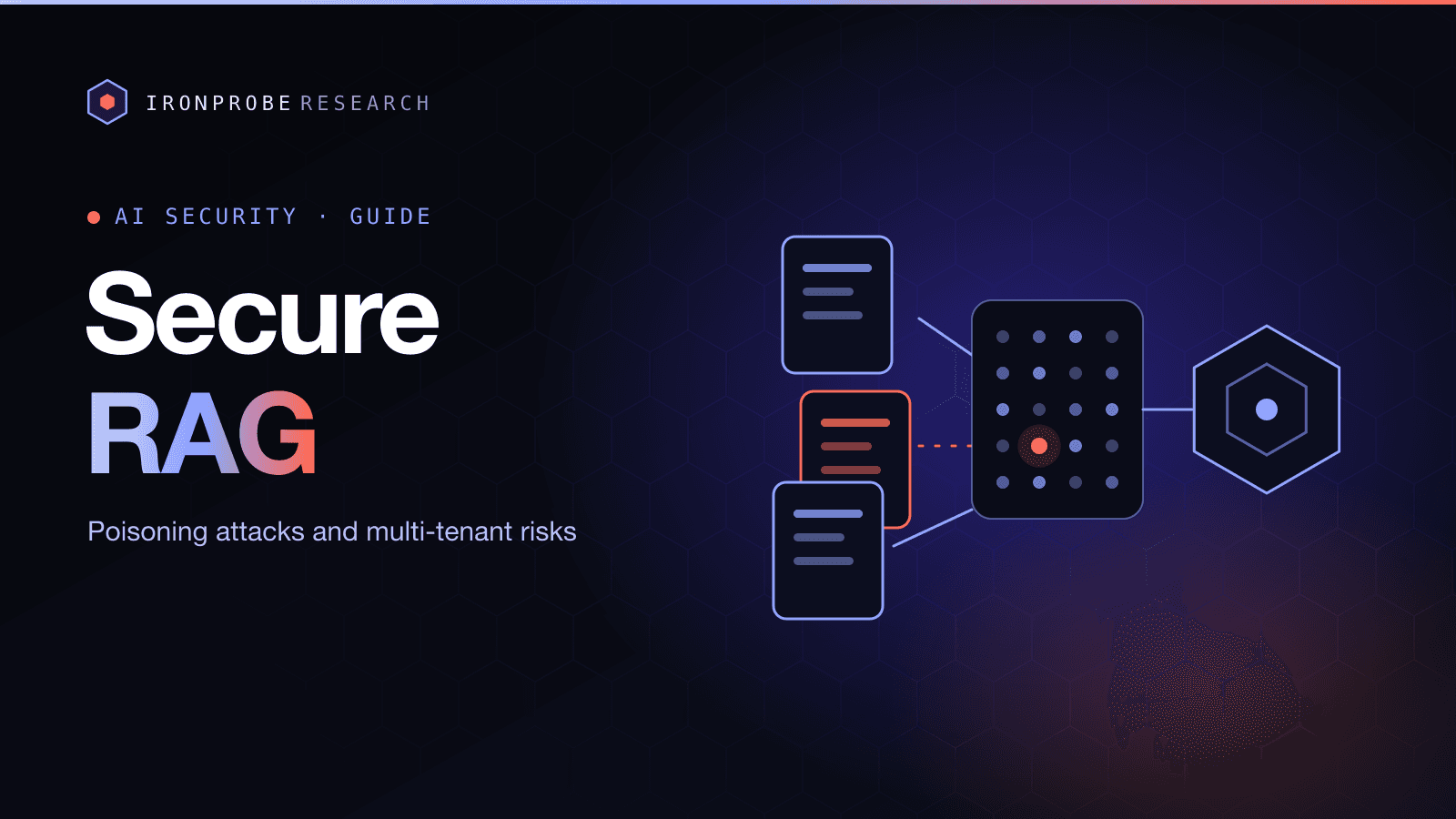
RAG poisoning is one of the most critical emerging threats in AI security. Instead of attacking the model directly, attackers target the knowledge base itself - the documents, embeddings, or vector database that the AI retrieves from. Once poisoned, the system does not just fail once. It fails consistently and confidently.
How RAG Poisoning Works in Practice
Attackers inject malicious or misleading content into the data sources that feed the RAG pipeline. This can happen through compromised documents uploaded internally, malicious content indexed from the web, insider manipulation of knowledge bases, or third-party data ingestion without validation. Once this data is retrieved, the AI treats it as trusted context.
Security research shows that poisoning attacks can silently manipulate outputs by corrupting retrieved context, effectively hijacking the AI's response generation process. More concerning, studies indicate that a single poisoned document can influence responses across complex queries, attack success rates can exceed 90 percent in real-world RAG systems, and attacks remain stealthy while bypassing traditional filters.
Why RAG Poisoning Is No Longer Theoretical
In 2025 and 2026, data poisoning moved from research papers into real production deployments. Security reports confirm that even tiny amounts of poisoned data can significantly alter model behavior, making detection extremely difficult.
In enterprise environments, this translates into AI giving incorrect business insights, security tools generating misleading alerts, and decision systems operating on corrupted intelligence. One particularly concerning pattern is index poisoning, where attackers insert malicious data into searchable knowledge sources and subtly influence AI outputs over time.
Every document should be treated like code and every embedding like sensitive data - because in a RAG system, they are.
Multi-Tenant RAG: Why Data Boundaries Break Down
As RAG adoption grows, multi-tenant architectures are becoming common - especially in SaaS platforms and enterprise tools. But this introduces a critical challenge: how do you ensure one user's data never appears in another user's AI responses?
In traditional systems, access control is enforced at the database or API level. In RAG systems, data is embedded into vectors, stored in shared indexes, and retrieved dynamically based on similarity. This creates a scenario where data boundaries become blurred at the retrieval layer - not at storage.
Key Risks in Multi-Tenant RAG
- Cross-tenant data leakage - AI retrieves another user's data due to similarity matches in shared vector indexes
- Embedding-level exposure - sensitive information reconstructed from vector embeddings without direct data access
- Authorization bypass - retrieval systems ignore original access control policies applied to the source documents
- Context mixing - responses generated using data from multiple tenants without any indication to the user
What Strong Multi-Tenant Access Control Looks Like
Designing secure multi-tenant RAG is not just about authentication - it requires context-aware authorization at every layer.
- Row-level and document-level permissions - every document must carry access metadata that follows it through ingestion and retrieval
- Query-time filtering - retrieval must enforce user-specific access rules, not just at storage time but at every query
- Tenant isolation at embedding level - separate indexes or strict partitioning to prevent cross-tenant similarity matches
- Zero-trust retrieval pipelines - never assume retrieved data is safe; validate authorization before surfacing context
At IronProbe, the most common pattern we observe in compromised AI systems is not model failure - it is misconfigured access controls in RAG pipelines that were never stress-tested under adversarial conditions.
PII in RAG Pipelines: The Silent Compliance Risk
While poisoning attacks target integrity, PII exposure targets privacy - and regulatory liability.
RAG systems routinely process internal documents, customer data, emails, communication logs, and knowledge bases containing sensitive information. The challenge is structural: RAG aggregates data from multiple sources, retrieves context dynamically, and generates responses based on that context - increasing the probability of unintentional data leakage with every query.
Common PII Failure Scenarios in RAG
- AI revealing customer details surfaced from internal document retrieval
- Sensitive emails included as context in unrelated responses
- Personal identifiers leaking across sessions due to shared retrieval state
- Unredacted sensitive data stored in query logs accessible to other systems
Research shows that RAG systems are vulnerable to data extraction attacks where sensitive information is reconstructed through repeated queries, even when the underlying documents appear inaccessible through normal channels.
Essential PII Controls for RAG Systems
- Data minimization before ingestion - only include data in the knowledge base that is necessary for the task
- PII redaction pipelines - remove or mask sensitive fields before documents are indexed into the vector store
- Access-aware retrieval - ensure sensitive data is only surfaced to authorized users during query execution
- Response filtering - apply output-level checks to prevent accidental PII exposure in generated responses
- Audit and logging controls - maintain a complete trail of who accessed what data and when
Failing to secure PII in RAG does not just lead to breaches - it leads to GDPR violations, enterprise data policy failures, and regulatory consequences that are far more expensive than the security investment required to prevent them.
Why RAG Security Is Fundamentally Different
One of the biggest misconceptions is that RAG is just an extension of LLM deployment. It is not.
RAG introduces a completely new attack surface - the external knowledge pipeline. Security research emphasizes that RAG risks are fundamentally tied to how systems retrieve and trust external data, not just how models generate responses. This means the attack surface is larger, the trust model is weaker, and the detection mechanisms are less mature than anything in traditional application security.
In RAG, you are not just securing a model. You are securing every data source it will ever read from.
How IronProbe Secures RAG Systems
Most organizations approach RAG security reactively - reviewing configurations after deployment, running basic access control checks, and hoping their vector database provider handles the rest.
IronProbe approaches it offensively and systematically. We simulate real-world attacks across the entire pipeline, not just at individual components.
IronProbe RAG Security Coverage
- RAG poisoning simulations - injecting malicious data at various pipeline stages to test system resilience and detection capability
- Retrieval-layer pentesting - breaking access controls and testing for cross-tenant and cross-session data leakage
- PII exposure testing - identifying sensitive data leaks across query patterns and user contexts
- End-to-end attack chain analysis - from data ingestion through retrieval to response generation
In real-world scenarios, attacks do not target one layer - they exploit the interaction between layers. IronProbe maps those interactions, identifies where trust assumptions break down, and helps organizations implement defenses that hold under actual adversarial pressure.
The Future of RAG Security
RAG adoption is accelerating faster than RAG security maturity. We are already tracking stealthy poisoning campaigns, multi-modal RAG attacks spanning text and images, data extraction through repeated query patterns, and supply chain compromises targeting knowledge base sources.
The most important insight for organizations to act on is this: RAG security is not a feature you add later - it is an architecture decision you make at the start. Systems designed without security in the retrieval pipeline cannot be patched into a safe state after deployment.
Final Thoughts
RAG has transformed how AI systems access knowledge. But it has also transformed how attackers exploit them.
If your AI system uses internal data, retrieves external content, or generates context-aware responses, your knowledge base is now a target. The question is no longer whether it can be attacked - but whether it has been tested.
The organizations that build security into their RAG architecture from the beginning will be the ones that deploy AI at scale without incident. Everyone else will be learning from their first breach.
IronProbe Security
Is Your AI Agent Actually Secure?
IronProbe specializes in AI agent security audits, adversarial prompt injection testing, and secure AI architecture design. We red-team your AI systems the way real attackers do - before they get the chance.