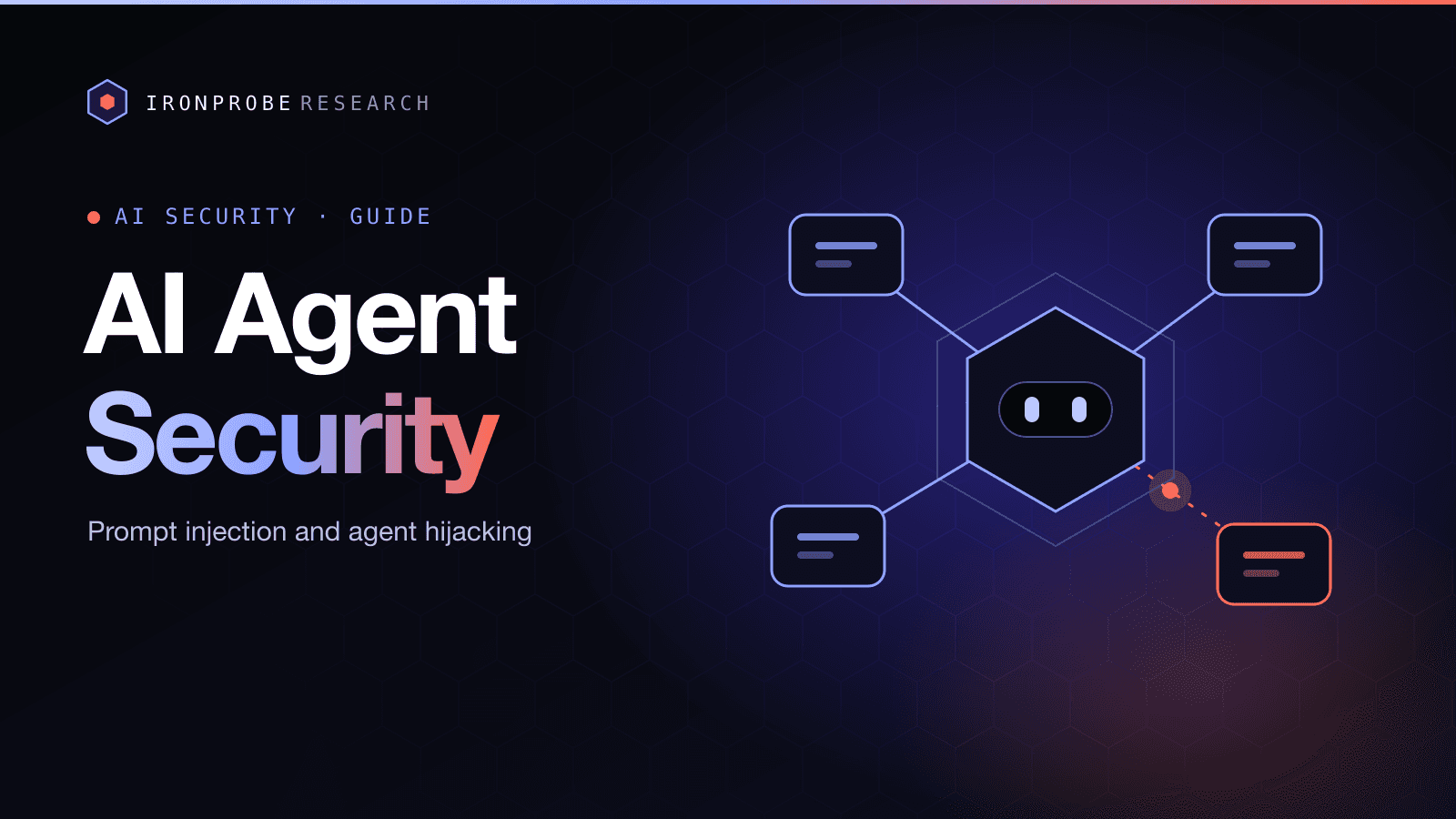
Why AI Agent Security Is the Fastest-Growing Cybersecurity Risk
AI agents are no longer passive tools. Today they execute multi-step workflows, call external APIs, access sensitive internal systems, and make decisions autonomously - without a human approving each action.
- Execute complex, multi-step workflows end-to-end
- Call APIs and interact with external services autonomously
- Access sensitive systems including databases, email, and SaaS tools
- Make decisions and take actions based on natural language reasoning
You are no longer securing code - you are securing behavior.
This shift introduces a new class of vulnerabilities where attacks happen via language, exploitation requires no traditional code execution, and conventional defenses fail silently. For organizations deploying AI in production, AI agent security is now a business-critical priority.
The 5 Ways AI Agents Get Hijacked (Real Threat Model)
1. Prompt Injection Attacks
Prompt injection is the most critical and least understood threat in agentic AI. An attacker manipulates input to override the agent's instructions - and the model cannot reliably tell the difference between legitimate instructions and malicious ones.
Why it works: LLMs cannot reliably distinguish system instructions from user data. Both share the same context window, and the model is optimized to be helpful - not adversarially robust.
Impact: Data exfiltration, unauthorized API calls, workflow hijacking, and impersonation of legitimate users.
How Ironprobe mitigates it: Prompt isolation architecture, adversarial input detection pipelines, and structured prompt frameworks that enforce trust boundaries.
2. Over-Permissioned AI Agents
The most common architectural mistake in AI deployments: giving agents broad system access because it is convenient. When an agent has full database access, unrestricted API permissions, or admin-level credentials, a single successful prompt injection becomes a catastrophic breach.
- Risk: A compromised agent can transfer funds, delete records, or impersonate users
- Fix: Least privilege access - agents get only what they need for the specific task
- Fix: Scoped, time-bound credentials rotated per session
- Fix: Role-based agent design separating read and write capabilities
3. Tool Exploitation (Execution Layer Attacks)
AI agents interact with APIs, code execution environments, and automation pipelines. This turns them into action-capable systems, not just reasoning engines. The attack pattern is simple and devastating:
- 1Attacker injects malicious prompt into agent's input
- 2Agent processes the input and decides to call a tool
- 3Tool executes the attacker-specified action on real infrastructure
Potential impact includes remote code execution, lateral movement across systems, and full infrastructure compromise - all triggered by a sentence in a document or webpage.
Mitigation: Tool allowlisting, sandboxed execution environments, strict parameter schema validation before any tool is invoked.
4. Data Exfiltration and Sensitive Leakage
AI agents commonly have access to internal documents, system prompts, and connected SaaS data. Sensitive information can be unintentionally included in outputs - and this looks like normal agent behavior, triggering no alerts.
A user asks the agent for a summary. The agent includes confidential internal configuration details it retrieved while generating the response. No alarm fires. The data is gone.
Solution: Output-level DLP filtering, automatic data redaction, and strict context separation between user-facing outputs and internal retrieval layers.
5. AI Supply Chain Attacks
Modern AI systems depend on external APIs, plugins, third-party tools, and RAG data sources. Attackers are now poisoning these upstream dependencies to influence agent behavior downstream.
The emerging trend is compound AI exploits - chaining multiple weak points across the supply chain to achieve an attack objective that no single vulnerability could accomplish alone.
- Verify and pin all AI dependencies and plugin versions
- Monitor third-party integrations for behavioral anomalies
- Maintain a live AI asset inventory covering every model, tool, and data source in the pipeline
Prompt Injection in Agentic Systems: A Practical Defense Guide
Prompt injection is a cybersecurity attack where malicious input manipulates an AI system to override its intended instructions and perform unauthorized actions. Unlike traditional injection attacks, there is no sanitization function that definitively prevents it at the model level.
The Four Types of Prompt Injection
- Direct Injection - explicit malicious command inserted into the prompt
- Indirect Injection - malicious payload hidden inside PDFs, emails, or web pages the agent reads
- Zero-Click Injection - no user interaction required; the agent fetches poisoned content autonomously
- Semantic Attacks - malicious intent disguised as roleplay, storytelling, or creative text that bypasses keyword-based filters
Why It Is Fundamentally Hard to Prevent
- LLMs are probabilistic, not rule-based - there is no deterministic filter
- Models are trained to optimize for helpfulness, which works against adversarial robustness
- Language is inherently ambiguous - the same sentence can be instruction or data depending on context
Ironprobe's Defense-in-Depth Approach
- Layer 1 - Input Security: Treat every external input as untrusted. Validate, sanitize, and classify before it reaches the model.
- Layer 2 - Context Isolation: Strictly separate system instructions from user inputs and retrieved external data using structural boundaries.
- Layer 3 - Tool Governance: Enforce structured, schema-validated tool calls. Reject free-form tool invocations.
- Layer 4 - Output Validation: Treat every agent response as untrusted. Run DLP and content policy checks before delivery.
- Layer 5 - Blast Radius Reduction: Scope permissions and credentials so a successful attack causes the minimum possible damage.
How to Secure Tool Permissions for AI Agents
Tool permission design is the single most critical engineering control in AI agent security. Most teams get this wrong because they optimize for developer convenience over security posture.
The Common Mistake vs. Secure Architecture
Six Best Practices for Secure Tool Design
- Least Privilege Access - Agents receive minimal permissions. Credentials are time-bound and rotated per session.
- Capability-Based Agent Design - Decompose into specialized agents: an email agent, a billing agent, an analytics agent. No single agent has cross-domain reach.
- Policy Enforcement Layer - Every tool call passes through a policy engine that validates intent, parameters, and context before execution.
- Human-in-the-Loop Gates - Payments, destructive actions, and external communications require explicit human approval.
- Sandboxed Execution Environments - Tool execution is isolated so a compromised tool cannot affect other system components.
- Full Observability and Logging - Every decision, tool call, and output is logged, timestamped, and anomaly-monitored.
Secure AI Agent Architecture: The Ironprobe Framework
A secure AI agent is not defined by a single control - it is defined by the layered architecture around it. Every layer assumes the previous one can fail.
Each layer is an independent control. A failure at one layer is contained by the next. This is not defense-in-depth as a buzzword - it is defense-in-depth as an engineering requirement.
AI Security Trends to Watch in 2026
- AI agents are becoming primary attack targets as they accumulate more system access and business logic
- Prompt injection remains an unsolved problem at the model level - defenses must live in the architecture
- Attackers are using AI to scale, automate, and personalize attacks at unprecedented speed
- AgentSec is emerging as a dedicated cybersecurity discipline alongside AppSec, CloudSec, and MLSec
- Regulatory frameworks are beginning to mandate AI security controls in high-risk industries
AI Agent Security Pre-Deployment Checklist
- All external inputs are treated as untrusted and validated before reaching the model
- System prompts are isolated from user inputs and retrieved external data
- All tools follow least-privilege scoping - no agent has more access than its task requires
- All agent outputs are validated against DLP and content policies before delivery
- Sensitive data is automatically detected and redacted from outputs
- Every agent action, tool call, and decision is logged with full audit trail
- High-risk actions (payments, deletions, external communications) require human approval
- Agents have been red-teamed with adversarial prompts before production deployment
Why Ironprobe
Most cybersecurity approaches still center on infrastructure hardening, code vulnerability scanning, and API security. These controls matter - but they were not designed for a world where the attack surface is natural language and the attack vector is a sentence in a document.
Security must focus on behavior, decisions, and autonomy - not just code and infrastructure.
Ironprobe specializes in AI agent security audits, adversarial prompt injection testing, secure AI architecture design, and real-world attack simulations against production AI systems. We work with security teams and AI engineering teams to build controls that hold up against actual attackers - not just theoretical threat models.
If your organization is deploying AI agents, the time to build security in is before your first incident - not after.
IronProbe Security
Is Your AI Agent Actually Secure?
IronProbe specializes in AI agent security audits, adversarial prompt injection testing, and secure AI architecture design. We red-team your AI systems the way real attackers do - before they get the chance.