AI systems are no longer standalone.
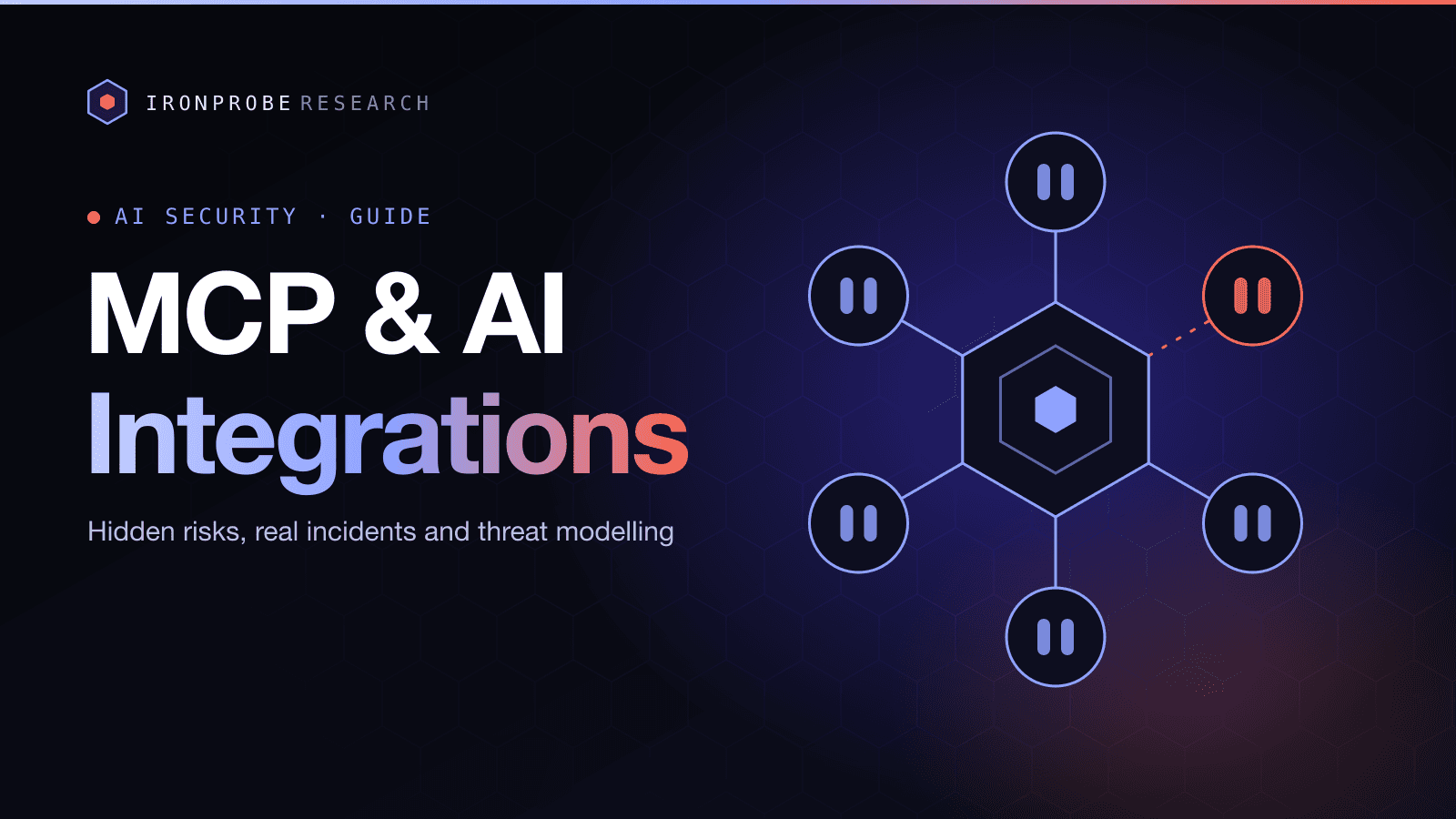
Today's enterprise AI does not just generate text - it connects, executes, retrieves, and acts. This shift is largely driven by the rise of the Model Context Protocol (MCP), which standardizes how Large Language Models interact with tools, APIs, and data sources.
On paper, MCP solves a massive engineering problem: instead of building custom integrations for every AI-tool combination, it provides a unified interface. In reality, it also introduces something far more dangerous - a universal attack surface for AI systems.
At IronProbe, we have observed a consistent trend - teams secure their APIs and infrastructure, but leave MCP integrations largely untested. That gap is already being exploited in the wild.
Why MCP Is a Security Game-Changer and Risk Multiplier
MCP fundamentally changes how AI interacts with systems. Instead of passive responses, LLMs can now query databases, execute system-level commands, access internal APIs, and trigger workflows across services. This happens through a structured client-server model where AI applications request tools from MCP servers and execute them dynamically.
That sounds efficient - but it also means your AI is no longer just generating responses. It is operating inside your infrastructure. And that is where the risk begins.
Recent reports show that MCP servers often store authentication tokens, execute commands on behalf of users, and access sensitive enterprise data. This effectively turns MCP into a high-privilege gateway. If compromised, attackers do not just get access - they get execution capability.
MCP Vulnerabilities Are Already Being Exploited
If MCP security still feels theoretical, it should not. A critical 2026 disclosure revealed that a vulnerability in MCP implementations enabled remote code execution across thousands of systems, affecting up to 200,000 servers. Even more concerning, the issue was not just a coding bug - it was rooted in protocol design decisions.
Other real-world findings make the picture clearer:
- Over 315 MCP-related vulnerabilities were identified in 2025 alone
- Malicious MCP packages have been found exfiltrating enterprise data undetected
- Supply chain attack vectors through compromised MCP tools have been confirmed in the wild
MCP is not just an integration layer - it is becoming a primary attack vector in AI systems.
MCP Security: What to Audit Before Going Live
Before deploying any MCP-based system, security teams need to shift from reactive fixes to proactive validation. A strong MCP security posture does not come from a single control - it comes from layered enforcement across identity, execution, and monitoring.
Identity and Access Control
- Enforce least privilege access for every tool
- Avoid static credentials - use short-lived tokens
- Ensure AI acts on behalf of users, not with elevated system privileges
Identity fragmentation is one of the biggest MCP weaknesses, often leading to impersonation and credential abuse.
Tool Execution Controls
- Maintain strict tool allowlists
- Validate all tool inputs and parameters before execution
- Prevent arbitrary command execution at the protocol layer
This is critical because MCP tools are essentially executable functions, not just data sources.
Input and Output Validation
- Filter prompt injection attempts at the input boundary
- Sanitize outputs before triggering downstream actions
- Monitor for abnormal AI behavior patterns
Integration and Supply Chain Security
- Audit all third-party MCP servers and plugins before use
- Verify tool authenticity and permission scope
- Prevent tool spoofing or silent replacement
MCP's open ecosystem makes it highly flexible - but also highly vulnerable to supply chain attacks.
Logging, Observability, and Isolation
- Track prompt to tool to action flows end-to-end
- Maintain full audit trails with timestamps
- Run MCP servers in isolated environments with restricted file system and network access
- Enable anomaly detection to catch behavioral deviations
At IronProbe, this checklist is just the starting point. Real security comes from testing how these controls behave under adversarial conditions.
Why Your MCP Server Needs Its Own Threat Model
One of the biggest mistakes organizations make is treating MCP as just another API layer. It is not.
An MCP server sits at the intersection of AI reasoning, tool execution, and data access. That combination creates unique risks that traditional threat models do not capture. Research shows that MCP systems suffer from implicit trust propagation - trust is passed across multiple components without proper validation, leading to attack paths that span the entire system.
What a Proper MCP Threat Model Must Cover
- LLM behavior risks - can the model be manipulated into unsafe actions?
- Tool interaction risks - what happens if a tool is compromised or misused?
- Data flow risks - where sensitive data enters, moves, and exits the system
- Trust boundaries - where user input, external data, and system instructions intersect
- Agent autonomy risks - what actions the AI can take without human validation
In real-world attacks, it is not one vulnerability - it is the interaction between components that leads to compromise. At IronProbe, MCP threat modeling is treated as a core security layer, not a compliance exercise.
Securing Claude and Enterprise AI Integrations
Enterprise adoption of tools like Claude is accelerating rapidly, especially in environments where AI agents interact with internal systems. But these integrations introduce new risks that go beyond standard LLM concerns.
Recent vulnerabilities in MCP-powered environments showed how attackers could inject prompts through development tools, manipulate UI interactions, and execute unauthorized commands across systems - without any obvious indicators of compromise.
Key Risks in Enterprise AI Integration
- Over-permissioned tool access with no scoping boundaries
- Lack of output validation before actions are executed
- Hidden prompt injection via documents, emails, and external data
- Cross-system trust exploitation through chained tool calls
These risks are amplified when AI is integrated with internal dashboards, DevOps pipelines, knowledge bases, and communication systems. A secure deployment requires strict permission boundaries, human-in-the-loop validation for critical actions, separation of instruction layers from data layers, and continuous testing for prompt injection and bypass techniques.
Why Traditional Security Approaches Fail Here
One of the biggest misconceptions is that existing security tools can handle MCP risks. They cannot - because MCP attacks are language-based rather than signature-based, behavior is dynamic and context-driven, and exploits happen at the AI reasoning layer.
Traditional security systems expect deterministic inputs and outputs. MCP systems do not behave that way. This is why vulnerabilities often remain invisible until they are actively exploited.
You cannot protect what you cannot observe - and most teams have zero visibility into MCP execution flows.
How IronProbe Secures MCP and AI Integrations
Most organizations are still experimenting with AI security. IronProbe operates differently - by treating MCP and LLM systems as high-risk, high-value attack surfaces that require the same rigor as production infrastructure.
IronProbe MCP Security Approach
- Full-stack MCP pentesting covering clients, servers, tools, and integrations
- Prompt injection and tool exploitation testing under real adversarial conditions
- Agentic threat modeling tailored to your specific architecture and data flows
- Real-world attack simulation, not checklist validation
We do not just identify vulnerabilities - we demonstrate how they can be exploited, and what it takes to fix them at the design level.
The Future of MCP Security
MCP adoption is accelerating faster than its security maturity. We are already seeing protocol-level vulnerabilities, supply chain compromises, and multi-agent attack chains that span multiple systems and execution contexts.
The most important insight for organizations to internalize is this: many MCP vulnerabilities are architectural, not just implementation bugs. That means they cannot be fixed with patches alone - they require design-level security thinking from the start.
Final Thoughts
MCP is redefining how AI systems operate. But with that capability comes a new category of risk - one that most organizations are still unprepared for.
If your AI connects to tools, accesses internal systems, or executes actions autonomously, you are already operating in an MCP-like environment. The only question is whether it has been properly secured and tested.
The organizations that invest in MCP security now will be the ones that scale AI safely, maintain trust, and avoid the incidents that will define the next wave of AI breaches.
IronProbe Security
Is Your AI Agent Actually Secure?
IronProbe specializes in AI agent security audits, adversarial prompt injection testing, and secure AI architecture design. We red-team your AI systems the way real attackers do - before they get the chance.